jungle-aura
Digital Night Vision Binoculars, 1080P with 2.8" Screen
Digital Night Vision Binoculars, 1080P with 2.8" Screen
Impossible de charger la disponibilité du service de retrait
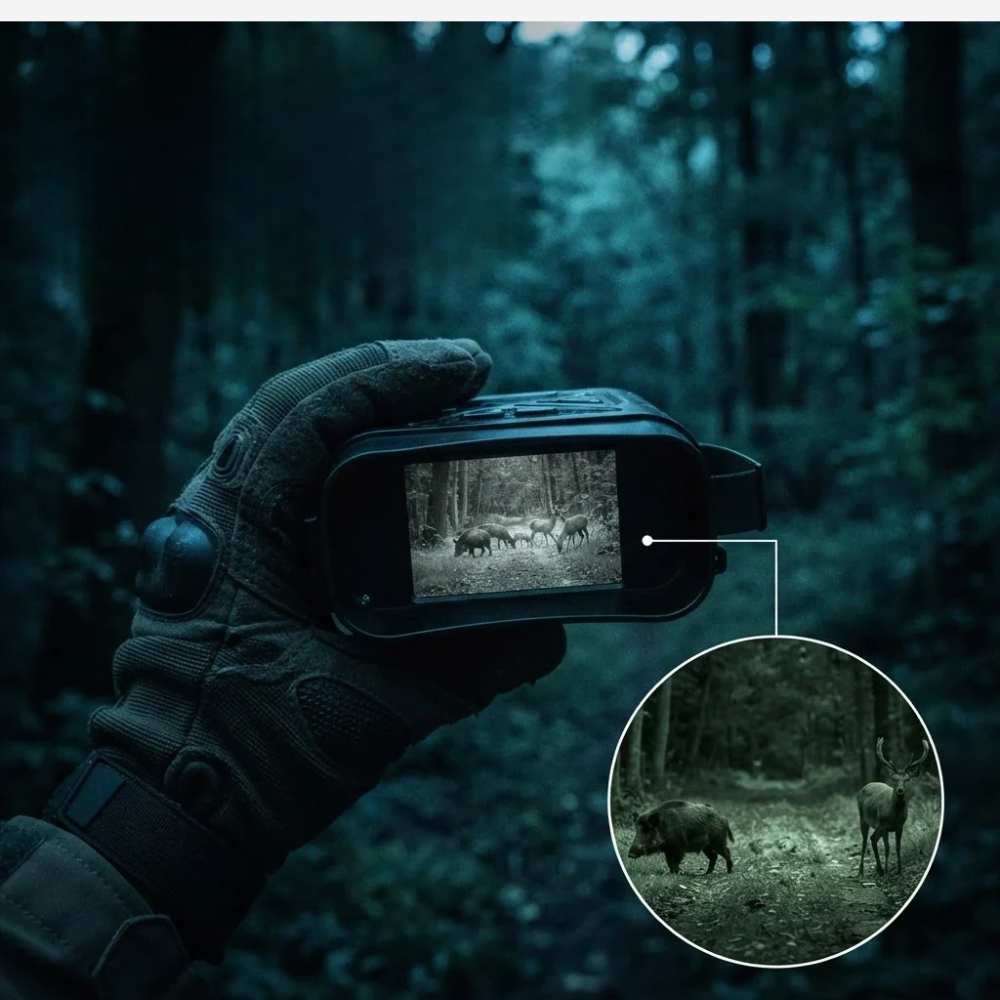
These digital night vision binoculars shoot 1080P photos and video on a 2.8-inch screen, in full color by day and in black and white at night thanks to an 850nm infrared illuminator with 7 brightness levels. A simple, affordable way to scout wildlife at dusk or keep an eye on your campsite after dark, for a fraction of what a thermal device costs.
- 850nm infrared, 7 levels: dial the IR down for close subjects so the image doesn't wash out, then turn it up for distance.
- 1920 × 1080 photo and video: record what you see and check the species later, or share the clip.
- 2.8-inch screen: you look through the eyepieces like regular binoculars, but the image comes from a single internal display.
- 10x digital zoom: enlarges the displayed image to frame a detail, with some loss of sharpness at full zoom.
- 2000mAh lithium battery, USB-C charging: about 3 hours of use for about 3 hours of charging.
- 16.8 oz (475 g): comfortable to hold with both hands and easy to pack in a daypack.
- Computer connection: transfer photos and videos over USB and view the live image on your laptop screen.
How infrared night vision binoculars work
These are not traditional optical binoculars with prisms. A digital sensor films the scene and sends it to the internal screen. In daylight, the picture is in color. When light runs out, two infrared emitters light up the area at a wavelength the human eye barely detects, and the image switches to black and white.
In practice, you see what the infrared beam reaches. The farther away a subject is, the less light it gets and the grainier it looks. That's normal for every digital night vision device in this price range.
About the 2,600 ft (800 m) claim. That's the manufacturer's maximum range in total darkness. Think of it as the farthest distance where a shape can still be picked out under ideal conditions, not the distance at which you can tell a deer from a coyote. Fog, rain and dense brush shorten it considerably.
Who they're for, and who should look elsewhere
A good fit if you want to
- watch deer, foxes, raccoons or hogs at the edge of a field or the back of your property after sunset;
- check what's moving around your tent, cabin or barn at night;
- try night vision with a device that also takes photos and video, without a learning curve.
Look elsewhere if you need
- to spot animals hidden in cover: infrared lights up the scene, it doesn't detect body heat. For that, you need a thermal monocular or binocular;
- optical magnification for daytime glassing: a pair of 8x42 or 10x42 optical binoculars gives a much sharper daytime view;
- all-night sessions: with about 3 hours of runtime, plan to recharge between outings.
Getting a clear image in the field
Three settings make the difference on your first night out.
- Focus is manual. Turn the objective focus ring until the image is sharp. Skip this step and everything looks blurry; it's the most common first-time mistake.
- Match the IR level to the distance. On a subject a few yards away, a high IR setting washes the picture out. Step it up gradually for distant subjects.
- Go easy on the zoom. Because the zoom is digital, stay on the lower steps to keep a usable picture, especially at night.
Good to know: seen from the front, 850nm emitters show a faint red glow. It doesn't light up the scene, but someone looking toward you may notice it.
Hunting regulations. Rules on night hunting and on using night vision or infrared illuminators to take game vary widely from state to state. Check your state wildlife agency's regulations before using these binoculars for any hunting activity.
What's in the box
- 1 pair of digital night vision binoculars
- 1 USB-C cable
- 1 carrying strap
- 1 user manual
Specifications
| Feature | Value |
|---|---|
| Type | Digital night vision binoculars, day and night use |
| Infrared illuminator | 850nm, 3W, 7 brightness levels |
| Claimed range in total darkness | Up to 2,600 ft / 875 yd (800 m), manufacturer figure |
| Zoom | 10x digital |
| Screen | 2.8 in (71 mm) |
| Photo resolution | 1920 × 1080 |
| Video resolution | 1920 × 1080 (1080P) |
| Image | Color in daylight, black and white in IR mode |
| Focus | Manual |
| Storage | Built-in memory (about 100 photos), expandable with a microSD (TF) card |
| Battery | Rechargeable lithium, 2000mAh |
| Runtime | About 3 hours |
| Charging time | About 3 hours |
| Port | USB-C (charging, file transfer, live view on a computer) |
| Housing | Plastic |
| Weight | 16.8 oz (475 g) |
| Color | Black |
Frequently asked questions
Do these night vision binoculars work during the day?
Yes. In daylight they show a full-color image and take 1080P photos and video. At night, the infrared illuminator takes over and the image switches to black and white.
How far can you see in complete darkness?
The manufacturer rates them up to 2,600 ft (800 m) in total darkness. That's a maximum detection range under ideal conditions; you'll identify an animal at a much shorter distance, depending on weather, vegetation and the IR level you choose.
How long does the battery last?
About 3 hours on the 2000mAh lithium battery, with a full recharge taking about 3 hours over USB-C. Charge them before every night outing.
Do I need a memory card?
Not to get started: the built-in memory holds about 100 photos. To record video or store more, add a microSD (TF) card. A card isn't listed in the box contents.
What's the difference between infrared and thermal binoculars?
Infrared binoculars light up the scene and film what the beam reaches, giving a detailed image of shapes. Thermal devices detect the heat animals give off, even behind tall grass, but they cost far more.